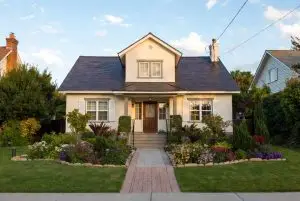
If you live in one of Topeka’s historic districts—like Potwin Place, Holliday Park, or the College Hill area—your home has character that modern builds simply can’t replicate. However, that charm comes with a unique set of structural challenges.
The foundations built in Topeka between the late 1800s and the mid-1940s weren’t just designed differently; they were built using materials and methods that react uniquely to the Northeast Kansas environment.
1. The Victorian Era: Limestone and Fieldstone (1880s–1900s)
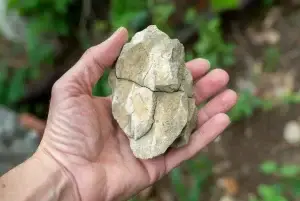
In neighborhoods like Potwin, many of the grandest homes rest on stacked limestone or fieldstone foundations.
- The Profile: These foundations are often massive, but they are held together by lime-based mortar that can dissolve over a century of exposure to groundwater.
- The Risk: As the mortar washes away, the stones can shift or “belly” inward. Unlike modern concrete, these walls are porous.
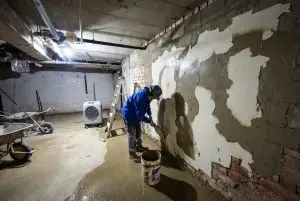
- The Solution: Protecting these homes often requires specialized basement waterproofing to manage the moisture that naturally seeps through the stone.
2. The Bungalow Boom: Concrete Block and Early Poured Walls (1910s–1930s)
As Topeka expanded near Washburn University and Holliday Park, builders shifted to concrete blocks (sometimes called “rock-faced blocks”) and early unreinforced poured concrete.
- The Profile: These foundations were a step forward in speed, but they lacked the internal steel reinforcement (rebar) used today.
- The Risk: Without rebar, these walls are highly susceptible to bowed basement walls caused by the intense hydrostatic pressure of Kansas clay.
- The Warning Sign: Horizontal cracks running along the mortar lines are a classic sign that the wall is struggling to hold back the earth.
3. Post-War Expansion: Poured Concrete (1940s–1950s)
In the neighborhoods surrounding the Kansas State Capitol and heading west, you’ll find more traditional poured concrete foundations.
- The Profile: These are more durable than stone, but they were often built without the advanced drainage systems we use today.
- The Risk: Over decades, the soil around these homes has settled, often leading to foundation settling vs. shifting issues.
- The Warning Sign: Stair-step cracks in the brickwork outside or vertical cracks inside the basement.
Why Historic Topeka Foundations Struggle
Topeka sits on a mix of glacial till and loess (wind-blown silt). For a century, these historic foundations have endured the toll of Kansas droughts and the expansion of wet spring seasons. Because historic foundations are often shallower than modern ones, they sit right in the “active zone” where soil moves the most.
Preserving Topeka’s History
Repairing a historic foundation requires a delicate touch. You can’t just throw a “quick fix” at a 100-year-old stone wall. We often recommend the Stratos Pier® System for historic homes because it provides deep-seated stability without putting undue stress on the fragile historic masonry.
Is your historic home showing its age? Don’t let a settling foundation erase decades of history. Schedule a free inspection with Advanced Systems of NE Kansas. We specialize in the “Topeka Profile” and know exactly how to keep your historic home standing tall for the next century.
Related Reading: